The Unintended Consequences of Progress: How Victorian Terraces Reveal the Limits of Design
The draft from that poorly insulated window isn't just cold air. It's a reminder that the future is always stranger than we imagine.
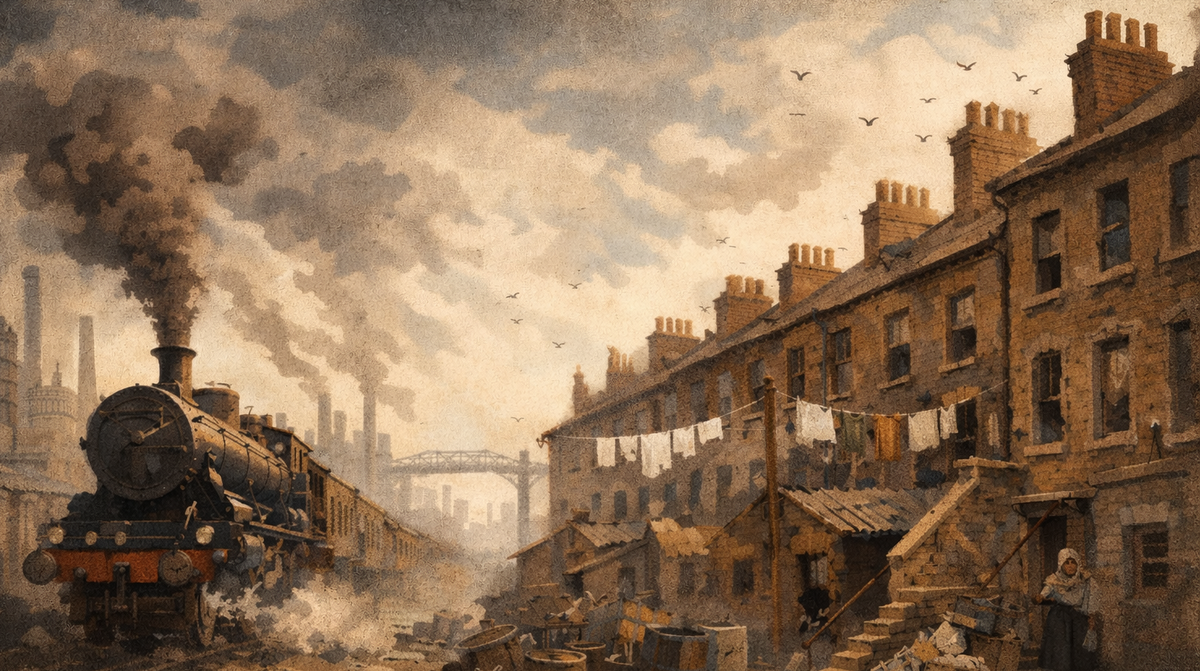
Stand in any Victorian terrace house on a cold winter morning and you'll likely feel it, that particular chill that seems to seep through the walls themselves. Modern homeowners curse the single-pane sash windows, the lack of cavity walls, the seemingly paper-thin party walls between houses. We retrofit insulation, install double glazing, and wonder: didn't the Victorians know anything about thermal efficiency?
They did. They just designed for a world we can barely imagine.
The Economics of Constant Fire
Victorian terrace houses weren't poorly insulated by accident, they were designed for homes where fires burned continuously throughout the day. Not occasionally. Not just in the evenings. All day, every day, throughout the heating season. The typical middle-class Victorian home might have fires in four or five rooms simultaneously: the drawing room, dining room, morning room, and bedrooms during illness.
This wasn't simply about comfort. It was about a fundamental organisation of domestic life that we've completely lost. Maintaining these fires was labour intensive, that required someone to be home constantly. Coal needed carrying from the cellar. Ashes needed removing. Grates needed cleaning and black leading. Fires needed laying, lighting, tending, and banking for the night. This was typically "women's work," performed by wives in working-class households and by female domestic servants in middle-class ones.
The 1871 census recorded that one in three women aged 15-20 in England and Wales worked as domestic servants. By 1891, there were 1.4 million domestic servants in England alone. The Victorian terrace was, in essence, designed around an assumption of readily available female labour, either unpaid or grossly underpaid.
A Thermal Ecosystem
With constant fires burning, Victorian terraces operated as entirely different thermal systems than they do today. The continuous heat source meant that party walls between houses didn't need insulation—your neighbour's fire helped warm your house and vice versa. The whole terrace functioned as a connected thermal mass, with each house contributing to and benefiting from the collective warmth.
The minimal external insulation made sense too. With internal heat sources running continuously, the primary concern was ventilation, not heat retention. In fact, Victorians worried obsessively about "bad air" and "miasmas." Those drafty sash windows and high ceilings weren't bugs, they were features, designed to ensure constant air circulation in rooms heated by coal fires producing carbon monoxide and particulates.
The Great Transition
Everything changed in the twentieth century, though not all at once. The decline of domestic service accelerated during World War I and became irreversible afterward. Women who'd worked as maids found better paid factory work and weren't coming back. The middle class housewife, now managing her home alone, couldn't possibly maintain multiple fires throughout the day while also cooking, cleaning, washing, and caring for children.
Central heating arrived gradually, first for the wealthy, then slowly filtering down through the classes over decades. Gas fires offered a compromise: easier than coal but still requiring someone to light them. The pattern of heating changed from "all rooms, all day" to "occupied rooms only" to our modern "programmed heating, twice daily."
But the houses remained the same. Those party walls that once benefited from bilateral heating now transmit sound and conduct cold. Those high ceilings that once dispersed coal smoke now just represent cubic metres of expensive space to heat. Those single-pane windows designed for an era of cheap coal and constant fires now haemorrhage expensive energy into the atmosphere.
The Impossibility of Future-Proofing
Here's what fascinates me about this: the Victorians weren't stupid. They were building for their present reality with intelligent, logical design decisions. They created homes perfectly adapted to a specific social and technological context. What they couldn't possibly anticipate was how completely that context would vanish.
Could they have guessed that domestic service would disappear? That women would enter the workforce en masse? That coal would be replaced by gas, then by programmable thermostats? That heating patterns would change from continuous to intermittent? That neighbours who once depended on shared thermal mass would instead complain about hearing each other's conversations through those same walls?
Of course not. And this is the humbling lesson for anyone designing or building anything meant to last: you're not just designing for how it will be used now, but for contexts and use cases you cannot possibly imagine.
We're making similar assumptions today. We're building "smart homes" assuming stable internet infrastructure, affordable energy, and consumer interest in managing dozens of connected devices. We're designing offices assuming certain patterns of work that are already shifting. We're creating infrastructure based on transportation models that might be obsolete in decades.
Living with Ghosts
There's something poignant about living in a Victorian terrace now. Every winter, millions of people experience the ghost of that vanished domestic world, not through historical records, but through their heating bills! The houses themselves are monuments to a form of life we've completely abandoned, embodying assumptions about gender, labour, and domesticity that we'd find intolerable today.
And perhaps that's the real lesson here, every design choice embeds assumptions about how life will be lived. The Victorian terrace assumed cheap fuel, gendered domestic labour, and continuous occupation. It was perfectly rational...until it wasn't.
The challenge isn't to design perfectly for the future. That's impossible. The challenge is to design with humility, recognising that our own "rational" assumptions will someday look as quaint and incomprehensible as maintaining five coal fires simultaneously.
The draft from that poorly insulated window isn't just cold air. It's a reminder that the future is always stranger than we imagine.